
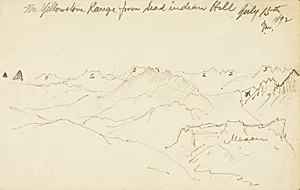
The Yellowstone Range from Dead Indian Hill
1892
Medium
Drawing
Classification
Drawing
Department
Smithsonian Collection
Museum
Smithsonian American Art Museum
Credit
Smithsonian American Art Museum, Gift of Dr. William Henry Holmes
Accession Number
1947.13.6
Rights
Public Domain
Tags
Art Historical Context
Thomas Moran's *The Yellowstone Range from Dead Indian Hill* (1892) captures the majestic sweep of Wyoming's Rocky Mountains and Yellowstone Range in a delicate drawing that evokes the untamed beauty of the American West. As a master landscape artist associated with the Hudson River School and luminism, Moran was renowned for his luminous depictions of natural wonders, often blending romantic grandeur with precise observation. This vista from Dead Indian Hill—now part of the Bighorn National Forest—highlights the dramatic peaks and vast horizons that defined the frontier imagination. Created over two decades after Moran's pivotal 1871 expedition with the Hayden Geological Survey, which produced sketches instrumental in establishing Yellowstone as America's first national park, this work reflects his enduring fascination with the region's geology and light. As a drawing in the Smithsonian American Art Museum's collection (gift of Dr. William Henry Holmes, a fellow explorer), it showcases Moran's skillful use of graphite or similar media to render atmospheric depth and texture, serving possibly as a study for larger oils. Housed in the Smithsonian, this piece underscores Moran's role in promoting conservation through art, inviting visitors to ponder the cultural and ecological significance of these iconic landscapes that shaped national identity in the late 19th century.
About the Artist
Thomas Moran · 1837–1926
Thomas Moran (1837–1926) was an American painter and printmaker of the Hudson River School whose dramatic paintings of the American West played a pivotal role in the creation of the national parks. Born in Bolton, Lancashire, England, he emigrated with his family to Philadelphia as a child. He was largely self-taught, though he apprenticed briefly with a wood engraver and studied the work of J.M.W...