
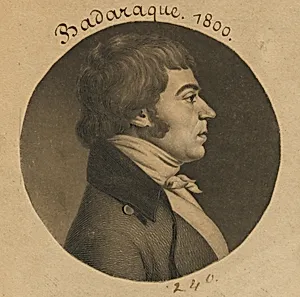
Thomas Badaraque
Medium
Classification
Department
Smithsonian Collection
Museum
Smithsonian American Art Museum
Credit
National Portrait Gallery, Smithsonian Institution; gift of Mr. and Mrs. Paul Mellon
Accession Number
S/NPG.74.39.6.7
Rights
Public Domain
Tags
Art Historical Context
In 1800, French-born artist Charles Balthazar Julien Fret de Saint-Mé captured the likeness of Thomas Badaraque this elegant profile print, a hallmark of his innovative portraiture in early America. Saint-Mémin, who fled the French Revolution to settle in the United States, pioneered the use of the physiognotrace—a mechanical device that traced precise outlines of a sitter's profile. He then engraved these on copper plates and hand-printed them, often adding subtle watercolor tints for lifelike effect. This technique made high-quality portraits affordable and portable, democratizing portraiture for the emerging American middle class. Thomas Badaraque, depicted here as a prosperous merchant and charity founder, embodies the entrepreneurial spirit of the young republic. Active around the turn of the century, Badaraque's philanthropy highlights the era's growing emphasis on civic responsibility amid rapid trade and urbanization. Housed in the Smithsonian American Art Museum through the generosity of Mr. and Mrs. Paul Mellon, this print from the National Portrait Gallery collection offers a window into Federal-era society, where individual success intertwined with community welfare. Saint-Mémin's meticulous profiles, like this one, influenced American printmaking and preserved the visages of overlooked figures, blending European precision with New World optimism. A testament to ingenuity and benevolence, it invites us to reflect on the faces shaping our nation's foundations.