
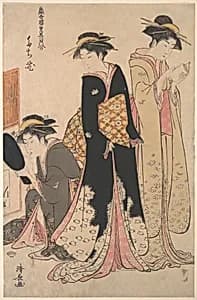
Three Geishas of Tachibana Street in Their Room
1784
Medium
Woodblock print; ink and color on paper
Dimensions
14 15/16 x 9 3/4 in. (37.9 x 24.8 cm)
Classification
Prints
Culture & Period
Japan · Edo period (1615–1868)
Department
Asian Art
Museum
Metropolitan Museum of Art, New York, NY
Credit
Henry L. Phillips Collection, Bequest of Henry L. Phillips, 1939
Accession Number
JP2800
Rights
Public Domain
Tags
Art Historical Context
Torii Kiyonaga’s “Three Geishas of Tachibana Street in Their Room” (1784) captures a quiet, intimate moment among three elegantly dressed women in an Edo-period pleasure district. Created during the height of ukiyo-e, the print belongs to the bijin-ga genre, which celebrated the beauty and daily lives of courtesans and geishas. Kiyonaga, a leading artist of the Torii school, was renowned for his graceful, elongated figures and harmonious compositions that conveyed both refinement and natural ease. As a full-color woodblock print (nishiki-e), the work demonstrates the technical sophistication of late-eighteenth-century Japanese printmaking, in which multiple blocks were carved to apply delicate hues of ink and color. The scene’s focus on mirrors and reading suggests a private interlude, offering viewers a rare glimpse behind the public performances of geishas on Tachibana Street. Today in the Metropolitan Museum’s collection, the print preserves the refined visual culture of Edo Japan and Kiyonaga’s lasting contribution to the portrayal of women in ukiyo-e.
About the Artist
Torii Kiyonaga · 1752–1815
Torii Kiyonaga, born Sekiguchi Shinsuke in 1752 in Uraga, Sagami Province, was the son of an Edo bookseller who owned tenements near a bustling fish market. At age 14 in 1765, he began his apprenticeship under Torii Kiyomitsu, the third-generation head of the prestigious Torii school of ukiyo-e, renowned for kabuki theater illustrations and signage. Adopted into the Torii family, Kiyonaga succeede...