
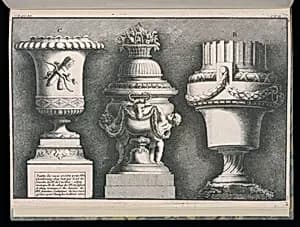
Three Vases
Medium
Bound print
Classification
Bound print
Department
Smithsonian Collection
Museum
Smithsonian American Art Museum
Credit
Purchased for the Museum by the Advisory Council
Accession Number
1921-6-282-86
Rights
Public Domain
About this artwork
Research in Progress
Art Historical Context
**Three Vases** *François de Cuvés the Younger (German, 1731–1777), 1770* Bound print; Smithsonian American Art Museum, Purchased for the Museum by the Advisory Council François de Cuvilli the Younger was a master of Rococo ornamentation, following in his father’s footsteps as a leading Bavarian architect and designer. Active in Munich’s royal courts, he created lavish interiors, furniture, and decorative prints that epitomized the elegant, playful curves of the Rococo style. This 1770 bound print, *Three Vases*, likely comes from one of his pattern books—collections of engravings shared designs with artisans across Europe, influencing everything from porcelain to silverwork. As a bound print, the medium itself highlights 18th-century innovation in design dissemination. Architects like Cuvilliés used precise etching techniques to capture intricate motifs—scrolls, shells, and floral flourishes—that defined luxury goods. By 1770, Rococo was yielding to Neoclassicism, making these vases a snapshot of stylistic transition, blending opulent asymmetry with emerging restraint. Housed in the Smithsonian American Art Museum’s collection, *Three Vases* underscores the transatlantic exchange of decorative arts. Though research is ongoing, it invites us to appreciate how such prints bridged courts and workshops, shaping tastes in an era of Enlightenment elegance.