
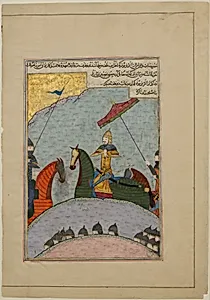
"Timur before Battle", Folio from a Dispersed Copy of the Zafarnama (Book of Victories) of Sharaf al-din 'Ali Yazdi
A.H. 839/ 1436 CE
Medium
Ink, opaque watercolor, silver, and gold on paper
Dimensions
H. 11 1/2 in. (29.2 cm) W. 8 in. (20.3 cm)
Classification
Codices
Department
Islamic Art
Museum
Metropolitan Museum of Art, New York, NY
Credit
Rogers Fund, 1955
Accession Number
55.121.16
Rights
Public Domain
Tags
Art Historical Context
Behold the striking folio *Timur before Battle*, a jewel from a dispersed 1436 copy of the *Zafarnama* (Book of Victories), authored the Persian historian Sharaf al-Din 'Ali Yazdi. Illustrated by Ya'qub ibn Hasan, known asaj al-Husaini, this page captures the mighty conqueror Timur—better known as Tamerlane—poised for war amid his soldiers and steeds. Measuring 11½ by 8 inches, it's a masterful example of Timurid manuscript art from the Metropolitan Museum of Art Islamic Art collection. The *Zafarnama* chronicles Timur's epic campaigns across Asia in the late 14th and early 15th centuries, glorifying his triumphs while subtly critiquing his brutality. Commissioned during the reign of Timur's grandson Ulugh Beg, this lavish edition reflects the cultural zenith of the Timurid court in Herat, where history and heroism intertwined to legitimize dynastic power. Such folios brought these tales vividly to life for elite patrons. Crafted with ink outlines, vibrant opaque watercolors, and shimmering silver and gold on paper, the artwork exemplifies Persian miniature techniques: intricate details of armored men, rearing horses, and dynamic compositions that convey tension and grandeur. These illuminated codices were treasures of Islamic scholarship and storytelling, blending historical record with artistic splendor.