
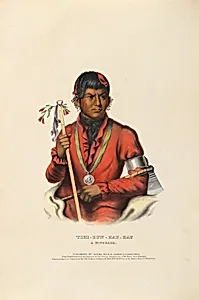
Tshi-zun-hau-kau - A Winnebago
Medium
Classification
Department
Smithsonian Collection
Museum
Smithsonian American Art Museum
Credit
National Portrait Gallery, Smithsonian Institution; gift of Betty A. and Lloyd G. Schermer
Accession Number
NPG.99.168.46
Rights
Public Domain
Tags
Art Historical Context
**Tshi-zun-hau-kau - A Winnebago** (1842) is a striking lithographic print by Alfred M. Hoffy, a Philadelphia-based artist active from 1835 to 1864 known for his detailed illustrations and portraits. This work captures the dignified profile of Tshi-zun-hau-kau, a Winnebago (Ho-Chunk) warrior, rendered with precise lines and subtle shading typical of mid-19th-century lithography. As a print from a book, it exemplifies how this medium democratized access to imagery, allowing portraits of prominent Native American figures to reach wide audiences beyond elite collectors. Created amid the turbulent era of U.S. westward expansion and Native treaties—like the 1832 Treaty of Lake Puckaway that pressured the Winnebago to cede lands in Wisconsin—the portrait preserves Tshi-zun-hau-kau's likeness at a pivotal moment. Hoffy's technique highlights the warrior's regalia and stoic expression, reflecting Romantic-era fascination with Indigenous nobility while underscoring the cultural documentation efforts of the time. Housed in the Smithsonian American Art Museum (gift of Betty A. and Lloyd G. Schermer), this piece from the National Portrait Gallery collection invites reflection on representation: a snapshot of Ho-Chunk resilience amid encroaching change, blending artistry with historical witness.