
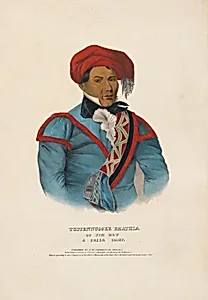
Tustennuggee Emathla or Jim Boy - A Creek Chief
Medium
Classification
Department
Smithsonian Collection
Museum
Smithsonian American Art Museum
Credit
National Portrait Gallery, Smithsonian Institution; gift of Betty A. and Lloyd G. Schermer
Accession Number
NPG.99.168.18
Rights
Public Domain
Tags
Art Historical Context
**Tustennug Emathla or Jim - A Creek Chief**1838) is a compelling portrait print capturing the dignified likeness of a prominent Creek Nation leader, also known as Jim Boy. by an unidentified artist, work from the Smithsonian American Art Museum's collection offers a rare visual record of Indigenous leadership during a pivotal era in American history Likely reproduced from a book illustration, the print reflects 19th-century conventions of portraiture, emphasizing the chief's stature through formal pose and attire that blend traditional Creek elements with Euro-American influences. The year 1838 places this artwork amid the devastating Trail of Tears, when the U.S. government forcibly removed the Creek people from their ancestral lands in the Southeast under the Indian Removal Act of 1830. Tustennuggee Emathla, a key figure in Creek resistance and negotiation, symbolized resilience amid profound cultural upheaval. Such prints served not only as historical documents but also as tools for public fascination with Native American figures, often circulated in books to educate or exoticize Indigenous leaders. Artistically, the print medium allowed for widespread dissemination, making elite portraiture accessible beyond oil paintings reserved for the wealthy. Donated to the National Portrait Gallery by Betty A. and Lloyd G. Schermer, it endures as a poignant reminder of Native sovereignty and the human cost of expansionism, inviting visitors to reflect on stories etched in ink and history.