
556
Medium
lithography
Dimensions
249; 338
Rights
Public Domain
About this artwork
blad: hoogte 338 mm x breedte 249 mm
Art Historical Context
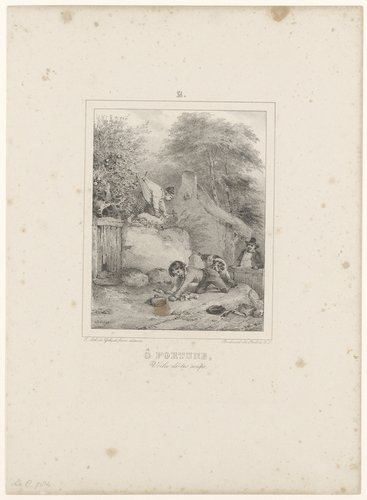
**Nicolas Toussaint Charlet's "556" (1832)** Created in 1832, this lithography by French artist Nicolas Toussaint Charlet measures 338 mm in height by 249 mm in width, capturing the intimate scale typical of 19th-century prints. Charlet (1792–1845), a master lithographer and veteran of Napoleon's Imperial Guard, was celebrated for his vivid, humorous portrayals of soldiers, barracks life, and everyday military scenes. His works often blended satire with nostalgia for the Napoleonic era, reflecting the cultural shifts in post-Revolutionary France during the July Monarchy. Lithography, a revolutionary technique pioneered around 1798, allowed Charlet to produce detailed, expressive images with the fluidity of drawing directly on stone. This medium democratized art, making affordable prints accessible to a broad audience and fueling the rise of caricature and illustration. "556," likely part of a numbered series, exemplifies Charlet's skill in evoking camaraderie and grit, offering a window into the era's social commentary. Though specifics of the scene remain elusive, Charlet's oeuvre underscores lithography's role in preserving France's martial spirit amid political change, inviting viewers to ponder the human side of history.
About the Artist
Nicolas Toussaint Charlet · 1792–1845
Comment on works: genre