
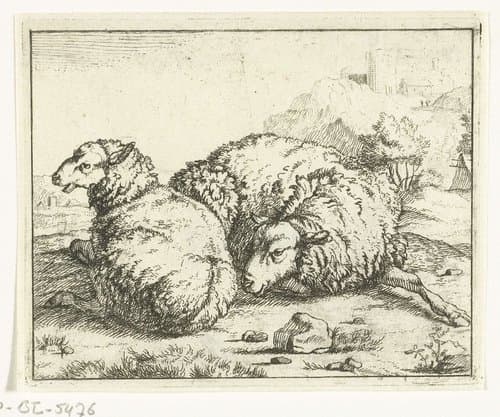
Twee liggende schapen, bergdorpje op achtergrond
1657 - ca. 1800
Medium
etching
Dimensions
68; 79
Rights
Public Domain
About this artwork
Kopie, in spiegelbeeld, naar zesde prent uit de serie schapen van Marcus de Bye.
Art Historical Context
Behold *Twee liggende sch, bergdorpje op achtergrond* (Two Recumbent Sheep, Mountain Village the Background), a delicate etching from the 17th to 18th century (1657–ca. 1800). This work captures a serene pastoral scene: two sheep resting peacefully in the foreground, with a quaint mountain village nestled the distant hills. Measuring just 68 × 79 mm, its scale invites close viewing, evoking the quiet beauty of rural life. Crafted as a mirror-image copy of the sixth print from Marcus de Bye's renowned *Sheep* series, it reflects the Dutch Golden Age's fascination with animal studies and landscapes. De Bye (1626–1681), a skilled engraver from Leiden, produced these detailed etchings to showcase naturalistic animal forms, blending meticulous observation with artistic elegance. Etching, a printmaking technique using acid to incise lines into a metal plate, allowed for affordable reproduction, spreading such idyllic imagery to collectors across Europe. This piece highlights the era's cultural appreciation for pastoral harmony, symbolizing tranquility amid the bustling Dutch trade economy. Though anonymous, the copyist's fidelity preserves de Bye's legacy, offering visitors a window into 17th-century artistry and the timeless charm of sheep in art.
About the Artist
anonymous
In the vast tapestry of art history, "Anonymous" stands not as a singular individual but as a collective designation for countless unidentified creators whose works have endured across millennia. These artists, spanning prehistoric cave painters to medieval illuminators and folk craftsmen, produced the foundational layers of human visual culture. Prior to the Renaissance, when individual fame emer...