
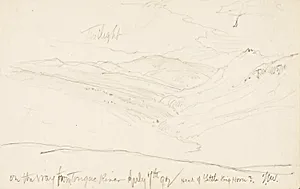
Twilight on the Way from Tongue River (Head of Little Big Horn?)
1892
Medium
Drawing
Classification
Drawing
Department
Smithsonian Collection
Museum
Smithsonian American Art Museum
Credit
Smithsonian American Art Museum, Gift of Dr. William Henry Holmes
Accession Number
1947.13.5
Rights
Public Domain
Tags
Art Historical Context
Thomas Moran's *Twilight on the Way from Tongue (Head of Little Big?)*, created in 1892, is a captivating drawing that captures the serene yet evocative beauty of the American West. As a leading figure in the Hudson River School and a pioneering of Western landscapes, Moran was renowned his expeditions into uncharted territories, sketching dramatic vistas that brought the Rockies to life for Eastern audiences. This work, housed in the Smithsonian American Art, exemplifies his skill in rendering twilight's soft, luminous effects through pencil or similar media, emphasizing atmosphere over fine detail. Set along the Tongue River in Wyoming's rugged Rocky Mountains—near the headwaters of the Little Bighorn, site of the infamous 1876 Battle of Little Bighorn—the drawing reflects the era's fascination with frontier exploration and Manifest Destiny. Moran's travels, including those with government surveys, documented these wild spaces, influencing public appreciation and preservation efforts for natural wonders like Yellowstone. Artistically, the piece highlights Moran's mastery of light and shadow, using twilight to evoke a sense of quiet transition between day and night. Its subtle tones and implied vastness invite viewers to ponder the West's untamed spirit, making it a poignant snapshot of 19th-century American romanticism in drawing form. (198 words)
About the Artist
Thomas Moran · 1837–1926
Thomas Moran (1837–1926) was an American painter and printmaker of the Hudson River School whose dramatic paintings of the American West played a pivotal role in the creation of the national parks. Born in Bolton, Lancashire, England, he emigrated with his family to Philadelphia as a child. He was largely self-taught, though he apprenticed briefly with a wood engraver and studied the work of J.M.W...