
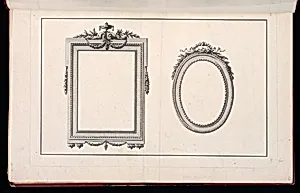
Two Frame Designs
Medium
Classification
Department
Smithsonian Collection
Museum
Smithsonian American Art Museum
Credit
Purchased for the Museum by the Advisory Council
Accession Number
1921-6-330-12
Rights
Public Domain
About this artwork
Research in Progress
Art Historical Context
**Two Frame Designs** by Richard de Lalonde, a French artist active from 1780 to 1796, dates to 1785–1788 and exemplifies the refined ornamental prints of late 18th-century France. a print, this work likely served as a practical pattern sheet for craftsmen, showcasing two elegant frame designs intended for pictures, mirrors, or furniture. Produced during the waning years of the Ancien Régime, just before the French Revolution, it captures the era's neoclassical elegance, where symmetry and classical motifs defined luxury interiors. Frame designs like these were essential to the decorative arts, bridging architecture and fine art. Lalonde's output reflects the period's demand for sophisticated ornamentation among the aristocracy and emerging bourgeoisie, disseminated via affordable prints that influenced workshops across Europe. The medium's reproducibility made such patterns accessible, standardizing high-style decoration. Acquired for the Smithsonian American Art Museum through the Advisory Council, this piece highlights transatlantic exchanges in design. Though research is ongoing, it invites us to appreciate how European ornamental traditions shaped global aesthetics, offering a window into the meticulous artistry of pre-Revolutionary France.