
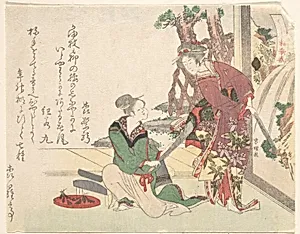
うし和歌春|Two Women, from the series Spring Poems on Ushiwaka for the Year of the Ox (Ushiwaka haru)
1805
Medium
Woodblock print (surimono); ink and color on paper
Dimensions
5 5/16 x 6 11/16 in. (13.5 x 17 cm) (trimmed)
Classification
Prints
Culture & Period
Japan · Edo period (1615–1868)
Department
Asian Art
Museum
Metropolitan Museum of Art, New York, NY
Credit
Henry L. Phillips Collection, Bequest of Henry L. Phillips, 1939
Accession Number
JP3002
Rights
Public Domain
Tags
Art Historical Context
Hishikawa Sōri's *Two Women, from the series Spring Poems on Ushiw for the Year of the Ox (Ushiwaka haru)* (1805) is a delicate woodblock print, or *surimono*, crafted during Japan's Edo period (1615–1868). Measuring just 5 5/16 x 6 11/16 inches, this intimate format was typical of *surimono*—privately commissioned prints often exchanged as New Year's greetings among poetry enthusiasts. Printed with vibrant inks and colors on paper, it captures two elegant women amid trees, evoking the serene beauty of spring in a style rooted in ukiyo-e traditions. The artwork belongs to a thematic series blending poetry and the Chinese zodiac, marking 1805 as the Year of the Ox (*ushi*). "Ushiwaka" refers to the youthful persona of the legendary warrior Minamoto no Yoshitsune, whose tales inspired playful, poetic interpretations. Sōri, a master of *surimono*, employed fine woodblock techniques for subtle gradations and metallic accents (implied in the luxurious production), making each print a collector's gem. Now in the Metropolitan Museum of Art's Asian Art collection, it highlights Edo Japan's vibrant print culture, where art, literature, and seasonal rituals intertwined to celebrate fleeting beauty.