
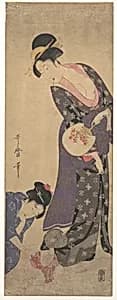
Two Women with a Baby who is Playing on the Floor
ca. 1793
Medium
Woodblock print; ink and color on paper
Dimensions
20 3/4 x 7 5/8 in. (52.7 x 19.4 cm)
Classification
Prints
Culture & Period
Japan · Edo period (1615–1868)
Department
Asian Art
Museum
Metropolitan Museum of Art, New York, NY
Credit
H. O. Havemeyer Collection, Bequest of Mrs. H. O. Havemeyer, 1929
Accession Number
JP1674
Rights
Public Domain
Tags
Art Historical Context
In the intimate woodblock print *Two Women with a Baby who is Playing on the Floor*, created around 1793 by the renowned Japanese artist Kitagawa Utamaro, we glimpse a tender moment of everyday domestic life during Japan's Edo period (1615–1868). Utamaro, a master of ukiyo-e—the "pictures of the floating world" that celebrated beauty, pleasure, and transience—specialized in bijin-ga, or images of beautiful women. Here, two elegant women attend to a playful infant on the floor, possibly wielding fans amid a serene indoor setting, evoking the quiet joys of motherhood and sisterly companionship. This color woodblock print, measuring 20 3/4 x 7 5/8 inches, exemplifies the technical brilliance of ukiyo-e production. Multiple woodblocks were meticulously carved and inked with pigments, then printed layer by layer on paper to achieve vibrant hues and subtle gradations—a process that made such art affordable and widely accessible to urban Edoites. Utamaro's delicate lines and soft shading highlight the women's graceful kimonos and poised expressions, humanizing them beyond mere beauty ideals. Housed in the Metropolitan Museum of Art's Asian Art Department as part of the H. O. Havemeyer Collection, this work captures the cultural reverence for family bonds in a bustling merchant society, offering visitors a window into 18th-century Japan's refined domestic world.
About the Artist
Kitagawa Utamaro · 1753–1806
Kitagawa Utamaro (c. 1753-1806) was one of the most celebrated masters of ukiyo-e woodblock printing, revolutionizing the art of bijin-ga (pictures of beautiful women) during Japan's Edo period. Born Kitagawa Ichitaro, his early life remains shrouded in mystery, with conflicting accounts placing his birth in Kyoto, Osaka, Yoshiwara in Edo (modern Tokyo), or Kawagoe in Musashi Province. Under the t...