
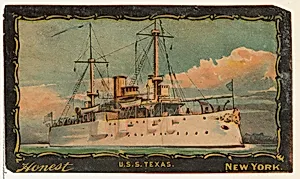
U.S.S. Texas, from the Transparencies series (N137) issued by W. Duke, Sons & Co. to promote Honest Long Cut Tobacco
late 1880s
Medium
Commercial color lithograph
Dimensions
Sheet: 2 1/2 × 4 3/16 in. (6.4 × 10.6 cm)
Classification
Prints|Ephemera
Department
Drawings and Prints
Museum
Metropolitan Museum of Art, New York, NY
Credit
The Jefferson R. Burdick Collection, Gift of Jefferson R. Burdick
Accession Number
63.350.207.137.19
Rights
Public Domain
Tags
Art Historical Context
Step into the vibrant world of 19th-century American advertising with *U.S.S. Texas*, a charming commercial color lithograph from W. Duke, Sons &.'s Transparencies series (N137). Produced in the late 1880s to promote their Honest Long Cut Tobacco, this petite print (just 2½ × 4⅜ inches) captures the mighty battleship U.S.S. Texas, symbolizing naval pride during a time of expanding American sea power. Tobacco companies like Duke's pioneered insert cards as clever marketing tools, enticing collectors—especially children—with colorful, themed series tucked into product packages. These "transparencies" were innovative ephemera, often translucent when held to light, showcasing chromolithography's bold hues and precise detail to make everyday promotions feel like treasures. W. Duke, Sons & Co., led by the ambitious James B. Duke, dominated the tobacco trade through such gimmicks, helping shift consumer habits toward branded cigarettes amid the Gilded Age's commercial boom. Today, housed in the Metropolitan Museum of Art's Drawings and Prints department from the Jefferson R. Burdick Collection, this piece highlights how advertising blurred art and commerce, preserving snapshots of history like the U.S.S. Texas's formidable silhouette for posterity. A delightful glimpse into Victorian-era hustle!
About the Artist
W. Duke, Sons & Co. · 1870–1920
**W. Duke, Sons & Co.: Pioneers of Chromolithographic Trade Card Art** W. Duke, Sons & Co., an American tobacco manufacturer, emerged from the entrepreneurial vision of Washington Duke (1820–1905) and his sons in Durham, North Carolina. After the Civil War, Washington abandoned farming in 1874 to join his eldest son, Brodie L. Duke, in the burgeoning tobacco trade, establishing a factory that for...