
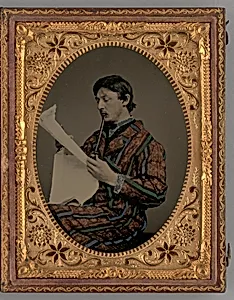
Untitled (Portrait of a Man Reading with Smoking Coat and Pipe)
1865
Medium
Ambrotype
Dimensions
Plate, approx: 10.3 × 7.6 cm (4 1/16 × 3 in.); Image, sight: 8.6 × 6.4 cm (3 7/16 × 2 9/16 in.); Open case: 11.8 × 18.8 × 0.9 cm (4 11/16 × 7 7/16 × 3/8 in.); Closed: 12 × 9.5 × 1.8 cm (4 3/4 × 3 3/4 × 3/4 in.)
Classification
portrait
Department
Photography and Media
Museum
Art Institute of Chicago
Accession Number
249955
Rights
Public Domain
Art Historical Context
This intimate ambrotype portrait, titledUntitled (Portrait of a Reading with Smoking Coat and)*, captures a bespectacled man in quiet contemplation, engrossed in a book while clad in a distinctive smoking coat and holding a pipe. Created by an unknown maker in 186, the image is rendered on a glass plate measuring about 10.3 × 7.6 cm, housed in a protective case—typical for preserving these delicate 19th-century photographs. Displayed in the Art Institute of Chicago's Photography and department, it exemplifies the's fascination with personal portraiture. Ambrotypes, popular from the mid-1850s to the 1860s, were unique positive images produced via the wet-collodion process: a glass plate coated with collodion, exposed while wet, and backed with black lacquer or velvet to create the illusion of a positive. Unlike reproducible prints, each ambrotype was one-of-a-kind, making it an accessible luxury for middle-class families during the post-Civil War years. This medium's crisp detail and subtle tones beautifully convey the man's relaxed intellectuality. Such portraits held cultural weight as cherished keepsakes, often exchanged among loved ones or treasured as mementos amid life's uncertainties. The smoking coat—a lounging garment for gentlemen—adds a touch of domestic sophistication, inviting us to ponder the anonymous subject's world in 1865 America. A window into everyday Victorian life, this small gem highlights photography's role in democratizing portraiture.