
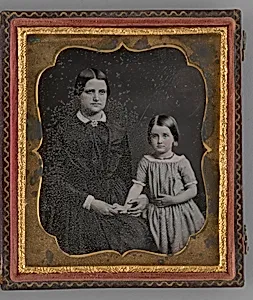
Untitled (Portrait of a Woman and a Child)
1850s
Medium
Daguerreotype
Dimensions
8.1 × 7 cm (3 1/4 × 2 13/16 in.); Open case: 9.2 × 16 × 1 cm (3 5/8 × 6 5/16 × 7/16 in.); Case: 9.2 × 8 × 1.6 cm (3 5/8 × 3 3/16 × 11/16 in.); Plate: 8.3 × 7 cm (3 1/4 × 2 3/4 in.)
Classification
portrait
Department
Photography and Media
Museum
Art Institute of Chicago
Accession Number
250008
Rights
Public Domain
Art Historical Context
Step into the intimate world of early photography with *Untitled (Portrait of a and a Child)*, poignant daguerreotype from the 1850s now housed in the Art Institute Chicago's Photography and Media Department. This tiny portrait, measuring just 8.1 × 7 cm on its silvered copper plate, captures a tender moment between a woman and child, framed within a protective case that opens like a locket—ideal for personal keepsakes carried close to the heart. Daguerreotypes, introduced in 1839, marked photography's public debut, producing one-of-a-kind, mirror-sharp images through a mercury vapor development process on polished metal plates. By the 1850s, they had surged in popularity for affordable portraits, democratizing what was once the privilege of painted miniatures for the elite. This unknown maker's work exemplifies the medium's technical marvel: its gleaming, positive image requires precise viewing angles under light, evoking a lifelike presence. Culturally, such family portraits reflected Victorian-era values of domesticity and sentimentality, preserving loved ones amid high mortality rates from disease and migration. Tucked in its 9.2 × 8 × 1.6 cm case, this piece whispers stories of everyday lives, bridging art and memory in photography's formative years.