
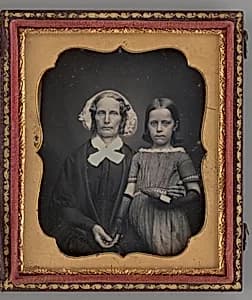
Untitled (Portrait of a Woman and a Girl)
1855
Medium
Daguerreotype
Dimensions
8.1 × 6.8 cm (3 1/4 × 2 11/16 in.); Open case: 9.2 × 16 × 1 cm (3 5/8 × 6 5/16 × 7/16 in.); Case: 9.2 × 8 × 1.5 cm (3 5/8 × 3 3/16 × 5/8 in.); Plate: 10.8 × 8.3 cm (4 1/4 × 3 1/4 in.)
Classification
portrait
Department
Photography and Media
Museum
Art Institute of Chicago
Accession Number
250025
Rights
Public Domain
Art Historical Context
Step into the dawn of photography with *Untitled (Portrait of a and a Girl)*, a poignant daguerreotype from 1855 now housed in the Art Institute of Chicago's and Media Department. This portrait captures a woman and young girl—likely mother and daughter—in a tender moment, their gazes meeting the viewer through the mirror-like sheen of the 8.1 × 6.8 cm plate. Encased in a protective thermoplastic union case (9.2 × 8 × 1.5 cm when closed), it exemplifies the jewelry-like treasures of early photography, small enough to wear or cherish privately. Created by an unknown maker, this work highlights the daguerreotype process, invented by Louis Daguerre in 1839 and patented just six years before widespread U.S. adoption. Mercury vapors developed a one-of-a-kind positive image on a silvered copper plate, requiring precise exposure times of minutes—sitters often braced with hidden stands for stillness. By 1855, daguerreotypes dominated portraiture, making professional likenesses affordable to the growing middle class, far beyond the elite realm of painted miniatures. This artifact whispers of mid-19th-century domestic life, where photography preserved fleeting family bonds amid rapid industrialization. Its technical fragility—sensitive to light and fingerprints—underscores a revolutionary shift: images that were unique, lifelike, and democratic, forever altering how we see ourselves. (198 words)