
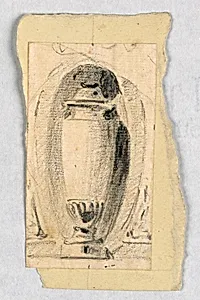
Urn in front of a niche
Medium
Drawing
Classification
Drawing
Department
Smithsonian Collection
Museum
Smithsonian American Art Museum
Credit
Museum purchase through gift of various donors and from Eleanor G. Hewitt Fund
Accession Number
1938-88-7326
Rights
Public Domain
About this artwork
Research in Progress
Art Historical Context
Giuseppe Barberi, a prominent Italian architect and designer active in Rome during the late 18th century, created *Urn in front of niche* around 1775. This delicate drawing exemplifies the Neoclassical movement's fascination with ancient Roman motifs, where urns—symbols of funerary art and classical grandeur—and niches (recessed wall spaces) were staples in architecture and interior decoration. Barberi, for his engraved pattern books of ornamental designs, likely produced this as a study for sculptural or architectural elements, reflecting the era's revival of antiquity amid Enlightenment ideals. As a drawing, the work highlights the preparatory precision essential to Neoclassicism, where artists used ink, chalk, or watercolor on paper to refine ideas before execution in stone or stucco. Barberi's meticulous lines capture spatial depth and proportion, inviting viewers to imagine the urn's placement in a grand palazzo or garden pavilion. Acquired by the Smithsonian American Art Museum through donor gifts, it bridges European design influences that shaped early American neoclassical architecture. Though research continues, this piece offers a window into 18th-century Italy's elegant fusion of form and symbolism, reminding us how everyday motifs like urns carried profound cultural weight. (198 words)