
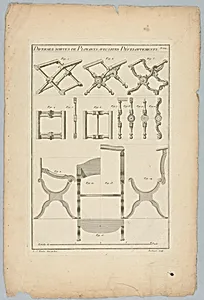
Various Types of Ployants and Their Development
Medium
Classification
Department
Smithsonian Collection
Museum
Smithsonian American Art Museum
Credit
Gift of Eleanor and Sarah Hewitt
Accession Number
1931-94-672
Rights
Public Domain
About this artwork
Research in Progress
Art Historical Context
Created in 1770 by French cabinetmaker and author André-Jacques Roubo (9–1791), *Various Types of Ploy and Their Development* is meticulously detailed print from his seminal multi-volume treatise *L'Art du menuis* (*The Art of the Cabinet*). This work, published during the Enlightenment, revolutionized woodworking by documenting intricate techniques with unprecedented precision, serving as both an instructional manual and a celebration of craftsmanship for apprentices and masters alike. The print illustrates different varieties of *ployants*—folding trestle tables or supports essential to 18th-century workshops—alongside diagrams of their mechanical development and assembly. Roubo's engravings, known for their clarity and technical accuracy, bridged art and engineering, allowing viewers to visualize complex joinery and folding mechanisms. As a print, it democratized specialized knowledge, making elite carpentry accessible beyond guild walls. Housed in the Smithsonian American Art Museum through a gift from Eleanor and Sarah Hewitt, this piece highlights the fusion of artistry and utility in pre-industrial France. It offers modern visitors a window into the ingenuity of Roubo's era, where innovation in everyday tools fueled the opulent furniture of Versailles and beyond. (198 words)