
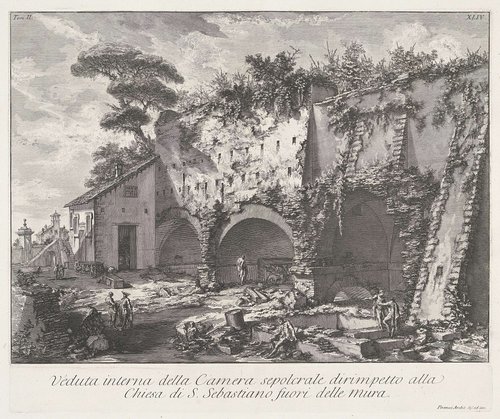
Veduta interna della Camera sepolcrale dirimpetto alla Chiesa di S. Sebastiano fuori delle Mura
c. 1756 - c. 1757
Medium
etching
Dimensions
505; 507; 48; 372
Rights
Public Domain
About this artwork
height 372 mm x width 505 mm x height 48 mm x width 507 mm
Art Historical Context
Step into the shadowy depths of ancient Rome with Giovanni Battista Pir's etching *Veduta interna della Camera sepolcrale dirimpetto alla Chiesa di S. Sebastiano fuori delle Mura* (c. 1756–1757). This intricate veduta, or "view," captures the haunting interior of a sepulral chamber opposite the Church of St. Sebastian outside Walls, a site tied to Rome's early Christian catacombs. Measuring 372 mm high by 505 mm wide, the print immerses viewers in crumbling arches, niches for tombs, and atmospheric gloom, evoking the mystery of the Eternal City's subterranean past. Piranesi, a virtuoso of 18th-century etching and a leading figure in the vedutisti tradition, transformed paper into a portal for Roman antiquities. His meticulous technique—layering fine lines and cross-hatching—renders stone textures and light shafts with dramatic intensity, blending precise archaeology with romantic sublime. This work likely belongs to his series documenting Rome's hidden wonders, produced during his fervent campaigns to record sites threatened by time and urban growth. For Grand Tour travelers and scholars, Piranesi's visions fueled a cultural obsession with antiquity, preserving fragile spaces like this chamber that whispered of persecuted Christians and imperial decay. Today, it invites us to ponder Rome's layered history through one man's visionary lens.
About the Artist
Giovanni Battista Piranesi · 1720–1778
Giovanni Battista Piranesi (1720–1778) was an Italian printmaker, architect, and antiquarian whose visionary etchings of Rome and imaginary prisons revolutionized architectural representation and profoundly influenced both Neoclassicism and Romanticism. Piranesi stands as one of the most important printmakers of the eighteenth century, fundamentally shaping European perceptions of ancient Rome an...