
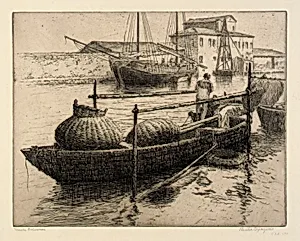
Venice Fisherman
1910-1917
Medium
Graphic Arts-Print
Classification
Graphic Arts-Print
Department
Smithsonian Collection
Museum
Smithsonian American Art Museum
Credit
Smithsonian American Art Museum, Gift of Chicago Society of Etchers
Accession Number
1935.13.492
Rights
Public Domain
Tags
Art Historical Context
Bertha E. Jaques' *Venice Fisherman*, created between 1910 and1917, captures the timeless charm of Venice's waterways through the delicate art of etching—a graphic print technique that allows for intricate lines and tonal depth. As a pioneering American printmaker and founder of the Chicago Society of Etchers, Jaques was at the forefront of the early 20th-century revival of fine art printmaking, blending technical precision with poetic observation. This work, now in the Smithsonian American Art's collection (gifted by the Chicago Society of Etchers), her skill in translating everyday scenes into evocative compositions. The print depicts a solitary male fisherman aboard a traditional gondola-like boat navigating Venice's narrow canals, evoking the city's romantic allure and the quiet rhythm of its working life. During this period, Venice fascinated artists for its luminous light and architectural splendor, and Jaques' etching highlights the textured water, weathered boat, and humble figure with masterful linework, inviting viewers to linger on the interplay of shadow and detail. This piece not only showcases Jaques' contributions to American graphic arts but also preserves a glimpse of pre-World War I Venetian culture, where fishing sustained local traditions amid growing tourism. A gem for print enthusiasts, it reminds us how etchings democratized art, making intimate scenes accessible to wide audiences.