
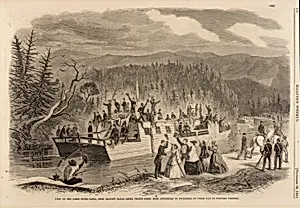
View on the James River Canal, near Balcony Falls. -Rebel Troops Going from Lynchburg to Buchanan, on Their Way to Western Virginia, from Harper's Weekly, September 28, 1861
1861
Medium
Graphic Arts-Print
Classification
Graphic Arts-Print
Department
Smithsonian Collection
Museum
Smithsonian American Art Museum
Credit
Smithsonian American Art Museum, Museum purchase
Accession Number
1972.85.15
Rights
Public Domain
Tags
Art Historical Context
Step back to the tense early days of the American Civil War with this vivid 1861 wood engraving from *Harper's Weekly*, a pioneering illustrated newspaper that brought distant events into American homes. Titled *View on the James River Canal, near Balcony Falls—Rebel Troops Going from Lynchburg to Buchanan, on Their Way to Western Virginia*, the unidentified artist's print captures Confederate soldiers ferrying along Virginia's vital James River Canal. Amid the rugged landscape near Balcony Falls, troops navigate boats laden with supplies, highlighting the Confederacy's reliance on inland waterways for rapid mobilization toward western campaigns. Printed on September 28, 1861, this graphic arts piece exemplifies the era's journalistic engraving techniques—precise lines etched on wood blocks for mass reproduction. *Harper's Weekly* artists often sketched on-site or from reports, offering authentic glimpses of war's logistics over glorified battles. Housed in the Smithsonian American Art Museum, it underscores the canal's strategic role in Virginia, a hotbed of conflict, and preserves a rare view of everyday Confederate movement. This artwork invites reflection on the Civil War's human scale: soldiers as both warriors and travelers on familiar rivers, blending natural beauty with wartime urgency. A museum purchase, it remains a poignant artifact of 19th-century visual reporting.
About the Artist
Unidentified ( ) · –