
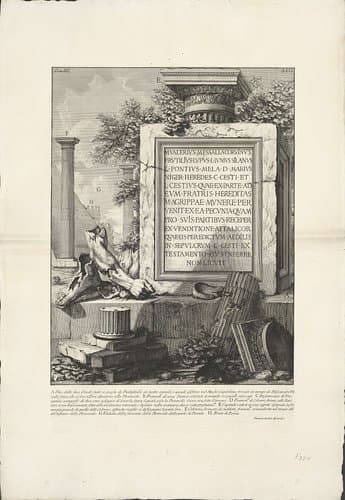
Voetstuk met inscriptie en fragmenten van zuilen en beelden
ca. 1756 - ca. 1757
Medium
etching
Dimensions
390; 515; 391; 51
Rights
Public Domain
About this artwork
ets gedrukt van twee platen op één blad
Art Historical Context
Step into the shadowy allure of ancient Rome with Giovanni Battista Piranesi etching *Voetstuk met inie en fragmenten van zuilen en beelden* (Base with Inscription and Fragments of Columns andues), created around 1756–1757. This monumental print, measuring 515 × 391 mm, captures the weathered remnants of classical grandeur—a pedestal bearing an inscription flanked by broken columns and sculptural fragments. Piranesi, a master of the vedute genre, immortalized Rome's ruins during the height of the Grand Tour era, when Europe's elite flocked to Italy to revel in antiquity's echoes. Piranesi's work embodies the 18th-century Romantic fascination with decay and sublime power, blending meticulous archaeological precision with dramatic imagination. As a Venetian architect-turned-printmaker, he elevated etching into a vehicle for neoclassical revival, inspiring architects like John Soane and fueling the era's obsession with Vitruvian ideals. This piece likely draws from his extensive Roman surveys, highlighting how fragments like these pedestal bases once supported imperial monuments, whispering tales of lost empires. Technically ingenious, the etching was printed from two plates joined on a single sheet, allowing Piranesi's intricate cross-hatching and tonal depth to unfold across vast surfaces. It invites visitors to ponder time's relentless march, bridging past and present in a single, haunting vista.
About the Artist
Giovanni Battista Piranesi · 1720–1778
Giovanni Battista Piranesi (1720–1778) was an Italian printmaker, architect, and antiquarian whose visionary etchings of Rome and imaginary prisons revolutionized architectural representation and profoundly influenced both Neoclassicism and Romanticism. Piranesi stands as one of the most important printmakers of the eighteenth century, fundamentally shaping European perceptions of ancient Rome an...