
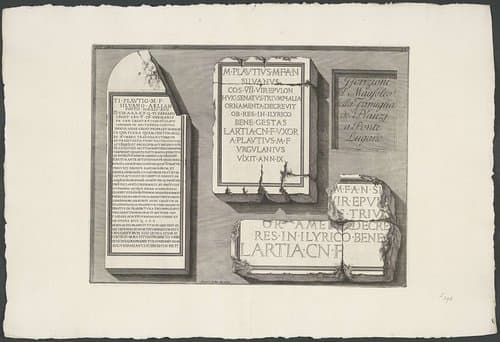
Inscripties uit het mausoleum van de Plauzi familie
ca. 1756 - ca. 1757
Medium
etching
Dimensions
524; 396
Rights
Public Domain
About this artwork
collector's mark: Lugt 2228
Art Historical Context
Step into the intricate world of 18th-century Rome with Giovanni Battista Piranesi's etching *Inscripties uit hetoleum van de Plau familie* (Inscriptions from theoleum of the Plauzi Family), created around 1756–1757. Piranesi, a visionary Venetian artist and architect, was renowned for his obsessive documentation of ancient Roman ruins during the Neoclassical era. This large-scale print (396 × 524 mm) captures detailed inscriptions from a family mausoleum, reflecting the era's fascination with classical antiquity amid the Grand Tour craze, when travelers sought to connect with Rome's imperial past. As a master etcher, Piranesi employed meticulous line work and dramatic contrasts to evoke the texture of weathered stone and the solemnity of funerary monuments. Etching allowed him to achieve unparalleled depth and atmospheric mystery, blending archaeological precision with romantic imagination—hallmarks of his style seen in series like *Vedute di Roma* and Roman antiquities portfolios. This technique not only preserved vanishing artifacts but also fueled the 18th-century revival of classical architecture across Europe. Bearing a collector's mark (Lugt 2228), this work highlights its esteemed provenance, inviting us to ponder the Plauzi family's legacy amid Rome's eternal echoes. A testament to Piranesi's genius, it bridges history and artistry for modern admirers.
About the Artist
Giovanni Battista Piranesi · 1720–1778
Giovanni Battista Piranesi (1720–1778) was an Italian printmaker, architect, and antiquarian whose visionary etchings of Rome and imaginary prisons revolutionized architectural representation and profoundly influenced both Neoclassicism and Romanticism. Piranesi stands as one of the most important printmakers of the eighteenth century, fundamentally shaping European perceptions of ancient Rome an...