
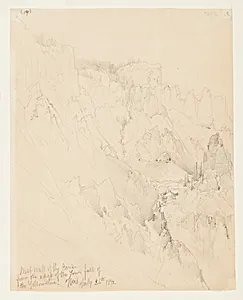
West Wall of the Canyon, Yellowstone
July 26, 1892
Classification
landscapes
Department
Smithsonian Collection
Museum
Smithsonian American Art Museum
Credit
Gift of Thomas Moran
Accession Number
1917-17-19
Rights
Public Domain
About this artwork
Research in Progress
Art Historical Context
Thomas Moran's *West Wall of the Canyon Yellowstone*, dated July 26, 1892, captures the awe-inspiring drama of Yellowstone National Park's Grand Canyon. Born in Britain and later a pivotal figure in American art, Moran1837–1926) was a master of the Hudson River School known for his luminous landscapes that celebrated the untamed beauty of the American. His works, gifted directly to institutions like the Smithsonian American Art (as with this piece helped fuel public enthusiasm for preserving natural wonders. Moran's Yellowstone paintings hold immense historical significance, stemming from his participation in the 1871 Hayden Geological Survey. His vivid depictions of the park's geothermal features and sheer canyon walls swayed Congress to establish Yellowstone as the world's first national park in 1872. Though created two decades later, this 1892 view of the West Wall reflects his lifelong fascination with the site's towering basalt cliffs, vibrant mineral streaks, and cascading Yellowstone River—elements he rendered with romantic grandeur and meticulous detail from on-site sketches. As part of the Smithsonian Collection, this landscape underscores Moran's role in shaping America's environmental consciousness, inviting visitors to ponder the enduring power of nature through his eyes. A true gift from the artist himself, it reminds us how art can advocate for wilderness preservation.