
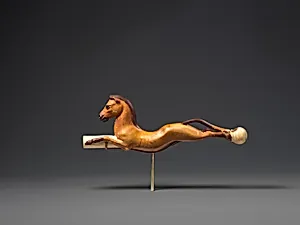
Whip Handle in the Shape of a Horse
Unknown Artist
ca. 1390–1352 B.C.
Medium
Ivory, garnet, paint
Dimensions
L. 14.7 × H. 5.5 × W. 2 cm (5 13/16 × 2 3/16 × 13/16 in.)
Classification
Whip handle, horse
Period
New Kingdom
Department
Egyptian Art
Museum
Metropolitan Museum of Art, New York, NY
Credit
Purchase, Edward S. Harkness Gift, 1926
Accession Number
26.7.1293
Rights
Public Domain
Tags
Art Historical Context
This elegant whip handle, crafted around 1390–1352 B.C. during Egypt’s New Kingdom Dynasty 18, captures the grace and power of a horse in miniature form. Created from smooth ivory and accented with inlays and traces of paint, the object measures just under six inches long, suggesting it was both a practical tool and a refined work of art. Horses had only recently become prominent in Egyptian society, introduced through trade and warfare, and they quickly symbolized speed, status, and royal authority. The unknown artisan skillfully shaped the ivory to follow the animal’s arched neck and alert head, turning a functional item into something lively and expressive. Such finely carved handles likely belonged to charioteers or members of the elite, reflecting the era’s growing emphasis on equestrian pursuits and the high value placed on imported materials like ivory. Today housed in the Metropolitan Museum of Art’s Egyptian Art department, the piece offers a vivid glimpse into the daily elegance of New Kingdom life, where even utilitarian objects celebrated the natural world and the prestige of their owners.