
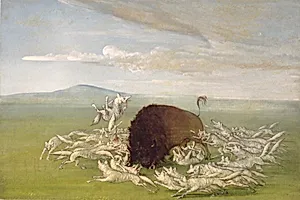
White Wolves Attacking a Buffalo Bull
1832-1833
Medium
Painting
Classification
Painting
Department
Smithsonian Collection
Museum
Smithsonian American Art Museum
Credit
Smithsonian American Art Museum, Gift of Mrs. Joseph Harrison, Jr.
Accession Number
1985.66.467
Rights
Public Domain
Tags
About this artwork
“Whilst the herd is together, the wolves never attack them, as they instantly gather for combined resistance, which they effectually make. But when the herds are travelling, it often happens that an aged or wounded one, lingers at a distance behind, and when fairly out of sight of the herd, is set upon by these voracious hunters, which often gather to the number of fifty or more, and are sure at last to torture him to death, and use him up at a meal. The buffalo, however, is a huge and furious a...
Art Historical Context
George Catlin's *White Wolves Attacking a Bull* (1832-1833) captures a dramatic moment from the untamed American West, painted during the artist's groundbreaking expeditions along the Upper Missouri River. a pioneering chronicler of Native American life and frontier wildlife, Catlin sketched these fierce wolves firsthand in 1832, later transforming his field notes into vivid studio paintings. This oil work, now in the Smithsonian American Art Museum reflects the 19th-century Romantic fascination with nature's raw power, just as European settlers began reshaping the Plains. In Catlin's own words from his 1841 *Letters and Notes*, the scene depicts wolves—sometimes numbering fifty or more—ambushing a lone, straggling buffalo separated from its herd. Far from passive prey, the massive bull fights desperately, tossing attackers into the air or trampling them underfoot in a brutal contest for survival. This portrayal underscores the precarious balance of prairie ecosystems, where buffalo herds formed defensive units but vulnerable individuals faced voracious predators. Catlin's realistic style, blending keen observation with dynamic composition, immortalizes a vanishing world. Donated to the Smithsonian, the painting offers visitors a window into pre-industrial America, highlighting the buffalo's cultural centrality to Indigenous peoples and the wild forces that shaped the land.
About the Artist
George Catlin · 1796–1872
George Catlin (1796–1872), born in Wilkes-Barre, Pennsylvania, to Putnam Catlin and Polly Sutton—who had been captured by Native Americans during the 1778 Battle of Wyoming—initially pursued a legal career. Trained at Litchfield Law School, he was admitted to the bar in 1819 but abandoned law after two years to study art in Philadelphia in 1823. Self-taught as a portraitist, Catlin quickly gained ...