
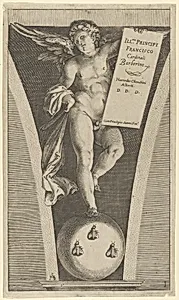
Winged genius holding a tableau, standing on a sphere with three bees
1570–1615
Medium
Engraving
Dimensions
Sheet: 11 9/16 × 6 13/16 in. (29.4 × 17.3 cm) Plate: 11 5/16 × 6 5/8 in. (28.8 × 16.8 cm)
Classification
Prints
Department
Drawings and Prints
Museum
Metropolitan Museum of Art, New York, NY
Credit
The Elisha Whittelsey Collection, The Elisha Whittelsey Fund, 1951
Accession Number
51.501.654
Rights
Public Domain
Tags
Art Historical Context
This engraving by Cherubino Alberti captures the elegance and symbolic richness of late Renaissance printmaking. Created between 1570 and 1615, the work depicts a winged genius—an allegorical figure often representing inspiration or divine favor—poised gracefully atop a sphere marked by three bees. Alberti, a Roman artist celebrated for his precise burin technique, specialized in translating sculptural and architectural motifs into detailed prints that circulated widely among collectors and artists. The composition’s unusual elements invite reflection on themes of balance, aspiration, and industriousness. The sphere suggests the precarious nature of fortune or the globe itself, while the bees, traditional emblems of diligence and harmony, add a layer of moral or heraldic meaning common in the period. As an engraving, the medium allowed Alberti to achieve fine tonal gradations and crisp lines, making complex allegories accessible beyond the walls of noble or ecclesiastical patrons. Housed in the Metropolitan Museum of Art’s collection of drawings and prints, this sheet exemplifies how sixteenth-century engravers blended classical mythology with contemporary symbolism to create visually compelling works that continue to fascinate viewers today.
About the Artist
Cherubino Alberti (Zaccaria Mattia) · 1553–1615
Cherubino Alberti (1553–1615), also known by his birth name Zaccaria Mattia, was an Italian engraver and painter active in Rome during the late Renaissance and early Baroque periods. Born in Borgo San Sepolcro in Tuscany, he came from an artistically inclined family and received training that equipped him for work in both painting and the reproductive graphic arts. It was as a printmaker, however,...