
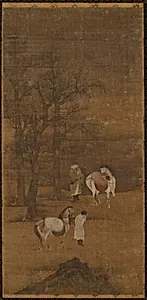
Winter landscape with horses and grooms
Classification
Painting
Department
Smithsonian Collection
Museum
Smithsonian American Art Museum
Credit
Gift of Charles Lang Freer
Accession Number
F1911.292
Rights
Public Domain
Tags
About this artwork
To 1911
Art Historical Context
**Winter Landscape with Horses and Grooms** This serene Chinese painting, formerly attributed to the renowned Yuan dynasty artist Zhao Mengfu1254–1322), depicts a tranquil winter scene alive with horses and their grooms. Snow-dusted landscapes and figures in harmonious motion capture the poetic essence of nature's quiet beauty, a hallmark of Chinese literati painting. Though created in the 17th century—spanning the late Ming (1368–1644) or early Qing (164–1911) dynasties—the work echoes Zhao's innovative style, blending calligraphy-like brushwork with subtle ink tones to evoke introspection and seasonal change. In Chinese art, such winter landscapes often symbolize resilience and the cyclical passage of time, while horses represent vitality, travel, and imperial grace. This piece reflects the enduring influence of scholar-artists who prized emotional depth over mere realism. Its provenance traces to 1911, entering the Smithsonian through the visionary collector Charles Lang Freer, whose passion for Asian art enriched American museums. Today, housed in the Smithsonian American Art Museum's Freer collection, it invites visitors to ponder the timeless dialogue between humanity and the natural world, bridging centuries of cultural reverence for the painted scroll.