
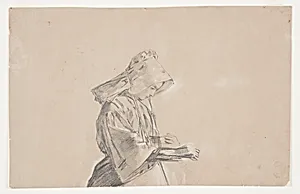
Woman in a Sunbonnet
Classification
figures
Department
Smithsonian Collection
Museum
Smithsonian American Art Museum
Credit
Gift of Charles Savage Homer, Jr.
Accession Number
1912-12-68
Rights
Public Domain
About this artwork
Research in Progress
Art Historical Context
**Woman in a Sunbonnet** (1874) by Winslow Homer captures the quiet dignity of everyday American life during the post-Civil War era. Homer, a pioneering American Realist (1836–1910), often depicted rural scenes and ordinary figures with unflinching honesty, drawing from his keen observation of nature and people. This work, classified as a figure study, likely portrays a woman in her traditional sunbonnet—a practical garment shielding against harsh sun and wind—evoking the resilient spirit of 19th-century rural women. Created in 1874, amid America's Gilded Age transition from agrarian roots to industrialization, the painting reflects Homer's fascination with authentic American experiences. Fresh from his Civil War illustrations and early Maine coastal works, Homer used bold compositions and natural light to convey emotional depth, making his subjects feel vividly alive. Though the medium is unknown, his signature Realism prioritized truth over idealization, influencing generations of American artists. A cherished piece in the Smithsonian American Art Museum, gifted by Charles Savage Homer, Jr., it exemplifies Homer's enduring legacy. Research continues to uncover more about its creation, inviting visitors to ponder the unassuming grace of this sunbonnet-clad figure in a changing nation. (198 words)