
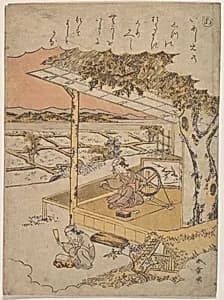
Woman on Veranda, Spinning; another Pounding Cloth on Rock in Foreground
Medium
Left-hand sheet of a diptych of woodblock prints (nishiki-e); ink and color on paper
Dimensions
H. 8 7/8 in. (22.5 cm); W. 6 7/16 in. (16.4 cm)
Classification
Prints
Culture & Period
Japan · Edo period (1615–1868)
Department
Asian Art
Museum
Metropolitan Museum of Art, New York, NY
Credit
H. O. Havemeyer Collection, Bequest of Mrs. H. O. Havemeyer, 1929
Accession Number
JP1758
Rights
Public Domain
Tags
Art Historical Context
**Woman on Veranda, Sp; another Pounding Cloth Rock in Foreground** Katsukawa Shunshō visitors into the vibrant world of Edo-period Japan (1615–1868). Shunshō, a leading ukiyo-e artist active in the mid-18th century, renowned for his graceful depictions of beautiful women (bijin-ga) and portraits. This print, the left of a diptych the Metropolitan Museum of Art H.O. Havemeyer Collection captures an intimate domestic scene one woman gracefully spinning thread a veranda amid lush trees while another pounds cloth on a rock in foreground, evoking the rhythm of everyday labor. Crafted as a nishiki-emeaning "brocade picture"—this woodblock print showcases the revolutionary full-color printing technique that flourished in Edo Japan. Ink and vibrant pigments on paper, measuring just 8⅞ × 6⁷⁄₁₆ inches, allowed for intricate layering of colors through multiple carved blocks, bringing subtle textures like flowing fabrics and leafy foliage to life. Diptychs like this were designed to be joined, creating panoramic views popular among urban collectors. In ukiyo-e tradition, celebrating the "floating world" of fleeting pleasures, Shunshō elevates mundane women's work into poetic beauty, highlighting their poise and harmony with nature. A window into 18th-century Japanese society, it reflects the era's fascination with daily life amid rapid urbanization. (198 words)
About the Artist
Katsukawa Shunshō 勝川春章 (Japanese) · 1726 –1792
Japanese, 1726–1792