
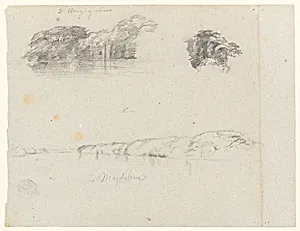
Wooded Banks along the Río Magdalena, Colombia
Classification
nature studies
Department
Smithsonian Collection
Museum
Smithsonian American Art Museum
Credit
Gift of Louis P. Church
Accession Number
1917-4-103
Rights
Public Domain
About this artwork
Research in Progress
Art Historical Context
Frederic Edwin Church, a leading figure of the Hudson River School, *Wooded Banks along the Magdalena, Colombia* in 1853 during his expedition to South America. Inspired by explorer Alexander von Humboldt's romantic visions of the tropics, Church journeyed up the Magdalena River, sketching the dense, verdant landscapes that captivated 19th-century American artists. This nature study captures lush riverbanks, reflecting his meticulous observation of exotic flora and atmospheric light—hallmarks of his luminist style, which emphasized nature's sublime beauty and divine order. As a preparatory work classified among Church's nature studies, this piece holds artistic significance for its role in his grander compositions, such as the monumental *Heart of the Andes* (1859). Church's oil sketches and drawings from this trip provided the vivid details that brought South America's wild terrains to life on canvas, blending scientific precision with transcendental awe. Though the medium remains unidentified amid ongoing research, it exemplifies how American landscape painters expanded their gaze beyond domestic scenes to global wonders. Today, housed in the Smithsonian American Art Museum as a gift from Louis P. Church, this work invites visitors to ponder the era's spirit of exploration and the artist's quest to document nature's majesty. A window into Church's process, it reveals the groundwork for paintings that awed audiences and shaped perceptions of the Americas.