
Worker Shabti of Nauny
Unknown Artist
ca. 1050 B.C.
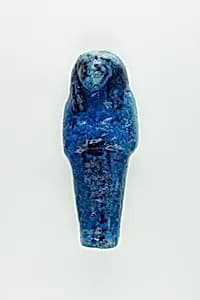
Medium
Faience
Dimensions
H 8.7 × W 3.3 × D 1.9 cm (3 7/16 × 1 5/16 × 3/4 in.)
Classification
Shabti, worker, Nauny
Period
Third Intermediate Period
Department
Egyptian Art
Museum
Metropolitan Museum of Art, New York, NY
Credit
Rogers Fund, 1930
Accession Number
30.3.26.71
Rights
Public Domain
Art Historical Context
Step into the mystical world of ancient Egypt with the *Worker Shabti of Na*, a petite faience figurine from around 1050 B.C. Crafted during Dynasty 21 of the Third Period, this 8.7 cm tall servant statue was designed to attend the noblewoman Nauny in the afterlife.tis like this one embodied the Egyptian belief that the deceased needed help with eternal labors—farming, building, or other tasks—so these magical workers would spring to life through inscribed spells, sparing the soul from toil. Made of vibrant blue-green faience—a glazed, quartz-based ceramic prized for its gem-like sheen and affordability—this shabti exemplifies mass-produced funerary art. Artisans molded and fired it to mimic lapis lazuli or turquoise, symbols of rebirth and the Nile's fertility. Its compact form (just 3.3 cm wide) hints at Nauny's elite status; high-ranking tombs held hundreds of such figures, activated by Chapter 6 of the Book of the Dead. Today, acquired through the Rogers Fund in 1930, this piece at the Metropolitan Museum of Art offers a window into Theban piety during a fragmented era when priestly families ruled southern Egypt. It reminds us of a culture obsessed with immortality, where even the smallest object pulsed with cosmic purpose.