
山岸半残宛書簡 (Yamagishi Hanzan ate shokan)|Letter to Yamagishi Hanzan
dated 1685 (Jōkyō 2)
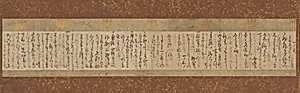
Medium
Letter mounted as a hanging scroll: ink on paper
Dimensions
Image: 5 3/4 × 43 1/2 in. (14.6 × 110.5 cm) Overall with mounting: 42 1/2 × 44 3/4 in. (108 × 113.7 cm) Overall with knobs: 42 1/2 × 46 7/8 in. (108 × 119.1 cm)
Classification
Calligraphy
Culture & Period
Japan · Edo period (1615–1868)
Department
Asian Art
Museum
Metropolitan Museum of Art, New York, NY
Credit
Mary and Cheney Cowles Collection, Gift of Mary and Cheney Cowles, 2020
Accession Number
2020.396.23
Rights
Public Domain
Art Historical Context
This exquisite hanging scroll features a personal letter written by Matsuo Bashō (1644–1694), Japan’s revered master of haiku poetry addressed to his disciple Yamagishi Hanz and dated 1685 during Edo period (1615–1868). Crafted in ink on paper, the delicate script measures 5¾ × 43½ inches, elegantly mounted for display with traditional knobs, evoking the intimate artistry of epistolary culture. Bashō, who revolutionized haiku with its emphasis on nature, transience, and simplicity, often corresponded with fellow poets, blending prose and verse in his writings. The letter exemplifies Bashō’s mastery of *shodo* (Japanese calligraphy), where fluid brushstrokes convey not just words but rhythm and emotion, akin to his poetic style. During this vibrant era of peace and cultural flourishing under the Tokugawa shogunate, such scrolls transformed everyday correspondence into treasured artifacts, displayed in homes or temples to honor the writer’s spirit. Hanging scrolls like this allowed viewers to unroll and savor the calligraphy seasonally, heightening its meditative appeal. A gift to the Metropolitan Museum of Art from the Mary and Cheney Cowles Collection in 2020, this piece invites us into Bashō’s world, bridging literature and visual art in Edo Japan’s refined aesthetic tradition.
About the Artist
Matsuo Bashō 松尾芭蕉 (Japanese) · 1644 –1694
Japanese, 1644–1694