
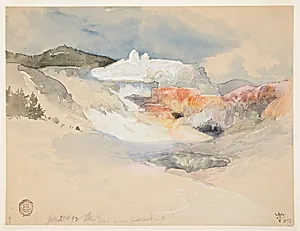
Yellowstone, Hot Springs
July 21, 1892
Classification
landscapes
Department
Smithsonian Collection
Museum
Smithsonian American Art Museum
Credit
Gift of Thomas Moran
Accession Number
1917-17-70
Rights
Public Domain
About this artwork
In the center, a hot spring of water, steam, and salt deposits is rendered in white, red and yellow tones. At left, in the distance, a wooded mountain under a deep blue sky.
Art Historical Context
Thomas Moran, the renowned American landscape painter born in Britain (1837–6), captured the raw majesty of Yellowstone National Park in *Yellowstone, Hot Springs on July 21, 1892. A master of the Hudson River School, Moran was celebrated for his luminous depictions of the American West, blending meticulous detail with dramatic effects. His expeditions, including the pivotal 1871 Hayden Geological, helped advocate for Yellowstone's establishment as the world's first national park in 2, making works like this a testament to 19th-century exploration and conservation. At the heart of the painting lies a vibrant hot spring, alive with swirling steam, water, and salt deposits in striking whites, reds, and yellows—colors that evoke the geothermal drama of Yellowstone's geysers and basins. To the left, a distant wooded mountain rises under a deep blue sky, framing the scene with serene depth and scale. Though the medium is unknown, Moran's characteristic use of bold tonality and light likely heightens the sense of wonder and otherworldliness. Gifted by the artist himself to what is now the Smithsonian American Art Museum, this landscape underscores Moran's lifelong passion for America's natural treasures, inviting visitors to marvel at the enduring beauty and geological power he so vividly preserved.