
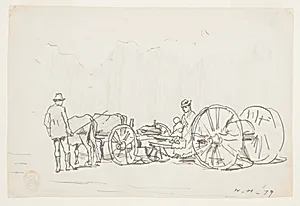
Yoke of Oxen
Medium
landscapes
Classification
landscapes
Department
Smithsonian Collection
Museum
Smithsonian American Art Museum
Credit
Gift of Charles Savage Homer, Jr.
Accession Number
1912-12-261
Rights
Public Domain
About this artwork
Research in Progress
Art Historical Context
**Yoke of Oxen** (1879) by Winslow Homer captures the rugged essence of 19th-century American rural life. Homer, a pioneering realist painter (1836–1910), shifted from Civil War illustrations to evocative scenes of everyday labor and nature during this period. Created amid his deepening fascination with the American countryside—often sketched in Maine or the Adirondacks—this landscape highlights the quiet strength of working animals, symbolizing the perseverance of frontier existence. Classified as a landscape, the work exemplifies Homer's masterful realism, likely rendered in oil or watercolor with precise brushwork that conveys texture, light, and movement. His technique emphasized natural drama without romantic idealization, influencing later American artists like the Ashcan School. The yoked oxen, central to the composition, evoke the era's agricultural backbone, before mechanization transformed farming. Now in the Smithsonian American Art Museum (gift of Charles Savage Homer, Jr.), this piece invites reflection on America's agrarian roots. Though research continues, it stands as a testament to Homer's enduring legacy in celebrating ordinary heroism amid vast, untamed landscapes.