
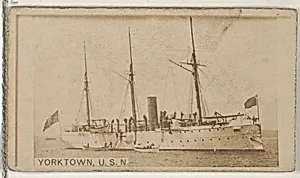
Yorktown, U.S.N., from the Famous Ships series (N50) for Virginia Brights Cigarettes
1895
Medium
Albumen photograph
Dimensions
Sheet: 1 1/2 x 2 5/8 in. (3.8 x 6.7 cm)
Classification
Photographs|Ephemera
Department
Drawings and Prints
Museum
Metropolitan Museum of Art, New York, NY
Credit
The Jefferson R. Burdick Collection, Gift of Jefferson R. Burdick
Accession Number
63.350.203.50.39
Rights
Public Domain
Tags
Art Historical Context
Step into the world of 19th-century collecting with *Yorktown, U.S.N.*, a petite albumen photograph from Allen & Ginter's Famous Ships series (N50), issued in 1895 to accompany Virginia Brights Cigarettes. These tiny cards—measuring just 1 1/2 x 2 5/8 inches—were tucked into cigarette packs as clever marketing ploys, sparking a collecting frenzy among smokers and enthusiasts alike. Produced by the innovative tobacco firm Allen & Ginter, pioneers of chromolithographic trading cards, this piece captures the sleek lines of the USS Yorktown, a steel-protected cruiser symbolizing America's growing naval ambitions during the Gilded Age. The albumen process, a hallmark of 19th-century photography, lent these ephemera a crisp, detailed realism, making distant ships feel vividly present. Part of the Metropolitan Museum of Art's Jefferson R. Burdick Collection—a treasure trove of American print ephemera—this card highlights the era's fusion of commerce, technology, and patriotism. As the U.S. Navy modernized post-Civil War, vessels like the Yorktown represented imperial reach, from Pacific patrols to the Spanish-American War horizon. Today, it evokes nostalgia for a time when everyday indulgences fueled passions for history and adventure, reminding us how fleeting paper artifacts preserved maritime might.
About the Artist
Allen & Ginter
Allen & Ginter, the pioneering American tobacco firm based in Richmond, Virginia, emerged around 1880 from the partnership of John F. Allen and Lewis Ginter, evolving from Allen's earlier John F. Allen & Company. Allen retired in 1882, succeeded by John Pope, yet the brand endured under Ginter's leadership, employing over 1,100 workers—mostly women—for hand-rolled cigarettes by 1886. Ginter, a Dut...