
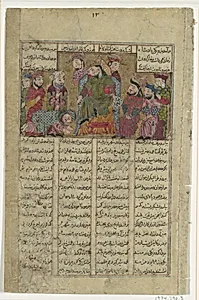
"Zal delivers Sam's letter to Manuchihr", Folio from a Shahnama (Book of Kings) of Firdausi
ca. 1330–40
Medium
Ink, opaque watercolor, gold, and silver on paper
Dimensions
Painting: H. 2 1/2 in. (6.4 cm) W. 4 5/16 in. (11 cm) Page: H. 8 in. (20.3 cm) W. 5 3/16 in. (13.2 cm) Mat: H. 19 1/4 in. (48.9 cm) W. 14 1/4 in. (36.2 cm)
Classification
Codices
Department
Islamic Art
Museum
Metropolitan Museum of Art, New York, NY
Credit
Bequest of Monroe C. Gutman, 1974
Accession Number
1974.290.3
Rights
Public Domain
Tags
Art Historical Context
Step into the heroic world of ancient Persia with this exquisite folio from Firdausi's *Shahnama* (Book of Kings), titled *"Zal Delivers Sam's Letter to Manhr."* Created around 1330–40, this miniature painting captures a pivotal moment in the epic poem: the white-haired warrior Zal presenting a letter from his father Sam to the king Manuchihr. The *Shahnama*, completed by the poet Abu'l Qasim Firda around 1010, is Iran's national epic, weaving tales of kings, heroes, and moral triumphs that shaped Persian identity for centuries. Rendered in ink, opaque watercolor, gold, and silver on paper, the artwork exemplifies the refined artistry of 14th-century Persian manuscript illumination. At just 2½ by 4⅜ inches, the painting bursts with vibrant colors and intricate details—figures in flowing robes, architectural backdrops, and shimmering metallic highlights that evoke a sense of royal grandeur. These techniques, typical of Islamic codices, transformed text into visual splendor, making epic narratives accessible to elite patrons. Housed in the Metropolitan Museum of Art's Islamic Art Department, this bequest from Monroe C. Gutman (1974) highlights the *Shahnama*'s enduring cultural legacy. Such folios not only preserved pre-Islamic myths but also bridged literary and visual traditions, influencing art across the Islamic world. A tiny window into a vast saga of valor and kingship!
About the Artist
Abu'l Qasim Firdausi · 935–1020
Abu'l Qasim Firdausi, born around 940 in the village of Paj near Tus in Khorasan (modern-day Iran), emerged from a family of landed gentry known as dehqans, who preserved ancient Iranian oral traditions amid the cultural renaissance of the Samanid Empire. Little is documented about his early life or formal training, though he likely received a basic education including Arabic literacy, immersing h...