
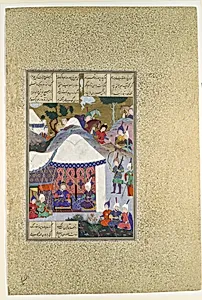
"Zal Questions Sam's Intentions Regarding the House of Mihrab", Folio 81v from the Shahnama (Book of Kings) of Shah Tahmasp
ca. 1525–30
Medium
Opaque watercolor, ink, silver, and gold on paper
Dimensions
Painting: H. 11 in. (28 cm) W. 7 1/8 in. (18.2 cm) Entire Page: H. 18 9/16 in. (47.1 cm) W. 12 7/16 in. (31.6 cm)
Classification
Codices
Department
Islamic Art
Museum
Metropolitan Museum of Art, New York, NY
Credit
Gift of Arthur A. Houghton Jr., 1970
Accession Number
1970.301.10
Rights
Public Domain
Tags
Art Historical Context
Step into the vibrant world of Persian epic storytelling with this exquisite folio from the *Shahnama* (Book of Kings) of Shah Tahmasp folio 81v, created around 1525–30. Titled "Zal Questions Intentions Regarding the House Mihrab," it a tense moment between the legendary heroes Zal and Sam, drawn from the immortal verses of the poet Abu'l Qasimdausi. Composed around 1010 CE, the *Shahnama* chronicles mythical kings and heroes, blending history, legend, and moral tales. This page hails from one of the most opulent manuscripts ever produced under Safavid Shah Tahmasp I, a testament to Persia's golden age of book arts. Illustrated by the master 'Abd al-'Aziz, the scene bursts with intricate details: noble men in flowing robes converse amid striped tents and prancing horses, rendered in opaque watercolor, ink, silver, and gold on paper. These radiant miniatures, measuring about 11 by 7 inches for the painting alone, exemplify Safavid techniques—fine lines for dynamic figures, jewel-toned hues for lush landscapes, and metallic accents that shimmer like treasures. Such codices were prized possessions of rulers, blending poetry, painting, and calligraphy into portable epics. Housed in the Metropolitan Museum of Art's Islamic Art Department (gift of Arthur A. Houghton Jr., 1970), this folio invites us to ponder ancient rivalries and loyalties, showcasing how Persian artists elevated manuscripts to high art, influencing Islamic illumination for centuries.
About the Artist
'Abd al-'Aziz|Abu'l Qasim Firdausi ( |Iranian) · 1500 |0935 –1550 |1020
active first half 16th century|Iranian, Paj ca. 940/41–1020 Tus