
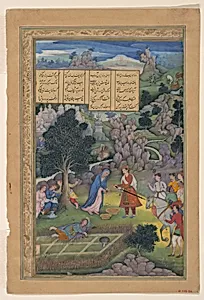
"A King Offers to Make Amends to a Bereaved Mother", Folio from a Khamsa (Quintet) of Amir Khusrau Dihlavi
1597–98
Medium
Main support: Ink, opaque watercolor, gold on paper Margins: Gold on dyed paper
Dimensions
H. 9 3/4 in. .(24.8 cm) W. 6 1/4 in. (15.9 cm)
Classification
Codices
Department
Islamic Art
Museum
Metropolitan Museum of Art, New York, NY
Credit
Gift of Alexander Smith Cochran, 1913
Accession Number
13.228.26
Rights
Public Domain
Tags
Art Historical Context
This exquisite folio, titled *"A King Offers to Makeends to a Bereaved,"* forms part of a luxurious *Khamsa* (Quintet), a renowned collection of five epic poems by the 14th-century Persian poet Amirusrau Dihlavi. Created around 1597–98 and illustrated by the masterful Mughal painter Miskin it captures a poignant moment of royal remorse amid tragedy. The scene likely draws from one of Khusra moral tales, featuring dynamic figures—a king in regal attire, a grieving woman, men with swords, horses, and animals—evoking themes of death, justice, and redemption in a bustling composition filled with emotion. Rendered in ink, opaque watercolor, and gold on paper, with shimmering gold margins on dyed paper, the artwork exemplifies the pinnacle of Mughal miniature painting under Emperor Akbar's patronage. Miskin's precise linework and vibrant hues bring the narrative to life on a compact page (9 3/4 x 6 1/4 inches), blending Persian storytelling traditions with Indian finesse. Gold accents highlight divine or royal elements, a technique symbolizing opulence and spiritual illumination in Islamic art. Housed in the Metropolitan Museum of Art's Islamic Art Department since 1913, this codex page reflects the cultural synthesis of the Mughal era, where poetry and painting intertwined to educate and entertain court elites. Visitors will appreciate its intricate details, revealing how 16th-century artists transformed words into vivid windows on human drama.
About the Artist
Miskin|Amir Khusrau Dihlavi · 1545–1630
Miskin, whose pen name translates to "the humble one" or "the poor," flourished as one of the preeminent painters in the opulent Mughal court of Emperor Akbar I (r. 1556–1605), active from the 1570s until around 1604.) Born circa 1560, he was the son of the artist Mahesh and brother to the painter 'Asi, both of whom contributed to the vibrant imperial workshop in Fatehpur Sikri and later Lahore.) ...