
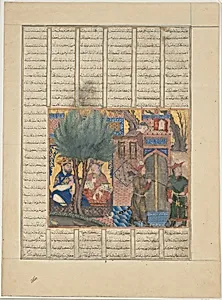
"Nushirvan Eating Food Brought by the Sons of Mahbud", Folio from a Shahnama (Book of Kings)
1330s
Medium
Ink, opaque watercolor, and gold on paper
Dimensions
Page: H. 20 3/4 in. (52.7 cm) W. 15 1/8 in. (38.4 cm) Painting: H. 8 1/8 in. (20.6 cm) W. 9 1/8 in. (23.2 cm) Mat: H. 22 in. (55.9 cm) W. 16 in. (40.6 cm)
Classification
Codices
Department
Islamic Art
Museum
Metropolitan Museum of Art, New York, NY
Credit
Purchase, Joseph Pulitzer Bequest, 1952
Accession Number
52.20.2
Rights
Public Domain
Tags
Art Historical Context
This exquisite folio, titled *"Nushirvan Eating Food Brought by the Sons ofbud"*, comes from a 1330s *Shahnama* (Book of Kings), the monumental Persian epic poem composed by Abu'l Qasim Firdausi around 1010. It captures a pivotal moment in the tale of the wise Sasanian king Nirvan (Khosrow I, r. 531–579 CE), renowned for his justice, as he shares a humble meal with the sons of a woodcutter named Mahbud. Surrounded by attendants—men and women depicted in vibrant scenes of communal eating—the illustration blends dynamic figures with elegant calligraphy, embodying the epic's themes of royal virtue and moral wisdom. Created in the Ilkhanid era of Persian manuscript production, this work exemplifies 14th-century Islamic art through its masterful use of ink for precise outlines, opaque watercolors for rich, jewel-toned hues, and gold accents that shimmer on the paper surface. Measuring about 8 by 9 inches for the painting itself, the folio is part of a luxurious codex designed for elite patrons, where text and image intertwine to narrate Iran's mythical history. Such miniatures were not just decorative but educational, preserving oral traditions in visual form. Housed in the Metropolitan Museum of Art's Islamic Art Department (acquired in 1952), this piece highlights the cultural pinnacle of Persian painting, where storytelling transcended pages to inspire generations with tales of equity and humanity.
About the Artist
Abu'l Qasim Firdausi · 935–1020
Abu'l Qasim Firdausi, born around 940 in the village of Paj near Tus in Khorasan (modern-day Iran), emerged from a family of landed gentry known as dehqans, who preserved ancient Iranian oral traditions amid the cultural renaissance of the Samanid Empire. Little is documented about his early life or formal training, though he likely received a basic education including Arabic literacy, immersing h...