
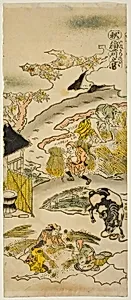
Autumn: Harvesting Rice (Aki: inekari no zu), No. 3 from the series "The Four Seasons of Farmers (Shiki no hyakusho)"
c. 1730s
Medium
Hand-colored woodblock print; hosoban, urushi-e
Dimensions
31 × 13 cm (12 3/16 × 3 in.); 31 × 13 cm (12 3/16 × 5/8 in.)
Classification
woodblock print
Department
Arts of Asia
Museum
Art Institute of Chicago
Accession Number
31635
Rights
Public Domain
Art Historical Context
Step into the vibrant world of Edo-period Japan with *Autumn: Harvesting Rice (Aki: inekari no zu)*, No. 3 from Torii Kiyomasu II's series *The Four Seasons of Farmers (Shiki no hyakusho)*. Created around the 1730s, this hand-colored woodblock print captures the rhythmic toil of rice harvesting, a cornerstone of rural life. Torii Kiyomasu II, a master of the Torii school—renowned for dynamic actor prints—here shifts focus to everyday peasants, blending ukiyo-e's "floating world" aesthetic with grounded genre scenes. Printed in the narrow *hosoban* format (31 × 13 cm), this *urushi-e* (lacquer print) showcases an early technique where colors mixed with nikawa glue were burnished for a glossy, jewel-like sheen, mimicking luxurious lacquerware on affordable paper. The intimate scale made such prints popular for personal collections or as calendar markers, democratizing art during Japan's prosperous Genroku era. This piece highlights rice's cultural primacy—symbolizing prosperity and sustenance in agrarian society—while offering a rare, empathetic glimpse into farmers' labor. Housed in the Art Institute of Chicago's Arts of Asia collection, it exemplifies how ukiyo-e evolved from theater imagery to celebrate the beauty in ordinary lives.
About the Artist
Torii Kiyomasu II · 1706–1763
At one point this artist was incorrectly identified as Kiyonobu II.