
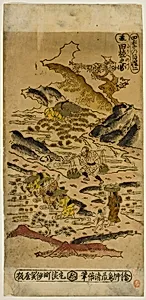
Summer: Planting Rice (Natsu: taue no zu), No. 2 from the series "The Four Seasons of Farmers (Shiki no hyakusho)"
c. 1730s
Medium
Hand-colored woodblock print; hosoban, urushi-e
Dimensions
33.7 × 16.1 cm (13 1/4 × 6 5/16 in.)
Classification
woodblock print
Department
Arts of Asia
Museum
Art Institute of Chicago
Accession Number
5150
Rights
Public Domain
Art Historical Context
Torii Kiyomasu II's *Summer: Planting Rice (Natsu: taue no zu)*, created around the 1730s, is the second print in the series *The Four of Farmers (Shiki hyakusho)*. As a master of the Torii school—renowned for vibrant ukiyo-e woodblock prints—this work captures the essence of rural summer labor in Edo-period Japan (1603–1868). The narrow *hosoban* format (.7 × 16.1 cm) was ideal for affordable, intimate viewing, reflecting the growing popularity of prints among urban audiences fascinated by everyday life. This hand-colored *urushi-e* (lacquer print) showcases an early color-printing innovation: a glossy, lacquer-like sheen achieved by applying nori paste or urushi to the woodblocks before inking, enhancing the vibrancy of hues like deep greens and blues. Unlike later full-color *nishiki-e*, this technique relied on meticulous hand-coloring, highlighting the artisan's skill in the collaborative woodblock process involving carvers, printers, and publishers. Culturally, the print elevates rice planting—*taue*—a communal ritual central to Japan's agrarian economy and Shinto traditions. Amid ukiyo-e's typical focus on kabuki actors and city pleasures, Kiyomasu II's series offers a rare, sympathetic glimpse into peasant life, bridging urban fantasy with rural reality for 18th-century viewers.
About the Artist
Torii Kiyomasu II · 1706–1763
At one point this artist was incorrectly identified as Kiyonobu II.