
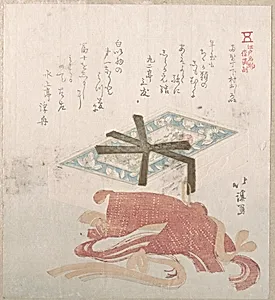
Box of Face Powder and Hair Ties; Specialities of Shimomura in Ryogaecho
19th century
Medium
Part of an album of woodblock prints (surimono); ink and color on paper
Dimensions
8 1/8 x 7 1/4 in. (20.6 x 18.4 cm)
Classification
Prints
Culture & Period
Japan · Edo period (1615–1868)
Department
Asian Art
Museum
Metropolitan Museum of Art, New York, NY
Credit
H. O. Havemeyer Collection, Bequest of Mrs. H. O. Havemeyer, 1929
Accession Number
JP2384
Rights
Public Domain
Art Historical Context
Step into the vibrant world of Edo-period Japan with *Box of Face Powder and Hair; Specialities of Shimomura in Ryogaecho*, a delicate surimono woodblock print Totoya Hokkei (0–1850). Created in the 19th century this intimate work from an album of prints measures just 8 1/8 x 7 1/4 inches, showcasing everyday luxuries like cosmetics and hair accessories from a shop in Ryogaecho, a bustling commercial district in Edo (modern Tokyo) famed for money changers and merchants. Surimono, meaning "printed things," were luxury woodblock prints commissioned for private occasions like New Year's greetings or poetry gatherings. Hokkei, a skilled ukiyo-e artist and pupil of the master Katsushika Hokusai, employed intricate techniques with ink and vibrant colors on paper, often enhanced by embossing or metallic pigments for a tactile, jewel-like effect. These prints blended art with subtle advertising, offering a window into urban consumer culture and the refined tastes of Japan's merchant class during the Edo period (1615–1868). Today, this gem from the H. O. Havemeyer Collection graces the Metropolitan Museum of Art's Asian Art department, inviting us to appreciate how Hokkei captured the ephemeral beauty of daily life in a format both artistic and commercial.
About the Artist
Totoya Hokkei · 1780–1850
Totoya Hokkei (魚屋 北渓, 1780–1850), born Iwakubo Tatsuyuki in Edo (modern Tokyo), began his life as a humble fishmonger in the Yotsuya Samegahashi district, a trade reflected in his art name "Totoya," meaning fish shop. He transitioned to art through rigorous training, first studying under Kanō Yōsen'in Korenobu, head of the Kobikichō branch of the prestigious Kanō school, where he honed landscape p...