
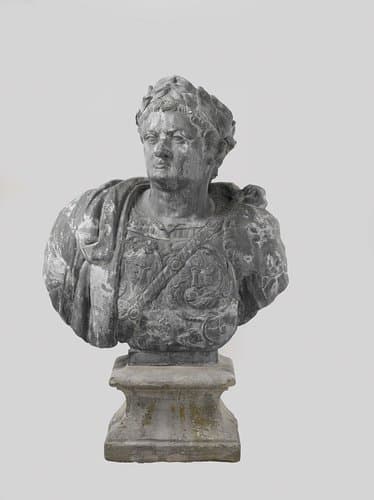
Buste van Titus Flavius Domitianus (51-96)
after 1674
Medium
lead
Dimensions
126; 175; 94; 43
Rights
Public Domain
About this artwork
…; country house Meer-en-Berg (near Heemstede), date unknown; from Paulina Agneta van Lennep-Deutz van Assendelft (1835-1913), country house Meer-en-Berg, with BK-B-68-A, -B, and -C, fl. 300 for all four, to the museum, through the mediation of the dealer B. Kalf, 1892
Art Historical Context
### Bust of Emperor Domitianus This striking lead bust portrays Titus Flavius Domitian (51–96 AD), the emperor of Rome's Flavian dynasty, ruled from 81 to96 AD amid a reign marked by military triumphs, architectural patronage, and eventual tyrannical rule that led to his assassination. Crafted by Dutch sculptor Bartholomeus Eggers after1674, the sculpture stands at 94 cm tall and weighs a substantial 175 kg, with a width of 43 cm—its hefty lead medium reflecting 17th-century European trends in durable outdoor or estate decorations, often more affordable than bronze yet capable of fine detailing. Eggers, active in the Netherlands during the late Baroque period, specialized in classical-inspired figures for grand country houses, blending Roman antiquity with contemporary sculptural techniques like casting in malleable lead for lifelike portraits. This bust exemplifies the era's fascination with imperial Roman history, revived through humanism and collecting among Dutch elites. Originally from the country house Meer-en-Berg near Heemstede, it entered the museum collection in 1892 via collector Paulina Agneta van Lennep-Deutz van Assendelft and dealer B. Kalf, part of a group purchase highlighting 19th-century efforts to preserve such historical treasures for public appreciation. A testament to enduring classical allure!
About the Artist
Bartholomeus Eggers · 1630–1692
Bartholomeus Eggers (c. 1637–1692) was a Flemish sculptor who spent the majority of his career in the Dutch Republic, contributing significantly to Amsterdam's monumental sculptural decoration during its Golden Age. Born in Antwerp, Eggers left his native city between 1650 and 1654 to participate in one of the seventeenth century's most ambitious sculptural projects: the decoration of Amsterdam's ...