
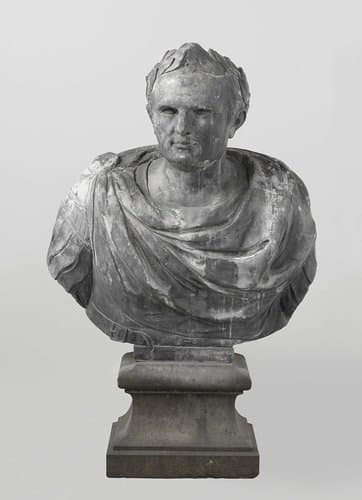
Julius Caesar
after 1674
Medium
lead
Dimensions
89; 43; 28; 175; 121
Rights
Public Domain
About this artwork
…; country house Meer-en-Berg (near Heemstede), date unknown; from Paulina Agneta van Lennep-Deutz van Assendelft (1835-1913), country house Meer-en-Berg, with BK-B-68-A, -C and -D, fl. 300 for all four, to the museum, through the mediation of the dealer B. Kalf, 1892
Art Historical Context
Behold the commanding lead sculpture *Julius Caesar* by Dutch artist Bartholomeus Eggers, created 1674. Standing at 89 cm tall, with a substantial weight of 175 kg, of 43 cm, and depth of 28, this robust piece captures the iconic Roman general and statesman in a medium more commonly associated with durable outdoor or garden figures than fine art display. Lead's malleability allowed Eggers to craft detailed features suited to the era's interest in classical antiquity, evoking the grandeur of Rome during the Dutch Golden Age. Eggers, active in the late 17th century, specialized in sculptural portraits that bridged historical reverence with contemporary Baroque sensibilities, often rendering leaders like Caesar to inspire awe and reflection on power and legacy. The choice of lead underscores its practical significance—resistant to weathering yet heavy and imposing—making it ideal for estate settings where such works symbolized cultural sophistication. This sculpture hails from the country house Meer-en-Berg near Heemstede, Netherlands, once owned by Paulina Agneta van Lennep-Deutz van Assendelft (1835-1913). In 1892, it entered the museum collection alongside related pieces (BK-B-68-A, -C, and -D) for 300 guilders, mediated by dealer B. Kalf, preserving a slice of Dutch aristocratic heritage for public admiration.
About the Artist
Bartholomeus Eggers · 1630–1692
Bartholomeus Eggers (c. 1637–1692) was a Flemish sculptor who spent the majority of his career in the Dutch Republic, contributing significantly to Amsterdam's monumental sculptural decoration during its Golden Age. Born in Antwerp, Eggers left his native city between 1650 and 1654 to participate in one of the seventeenth century's most ambitious sculptural projects: the decoration of Amsterdam's ...