
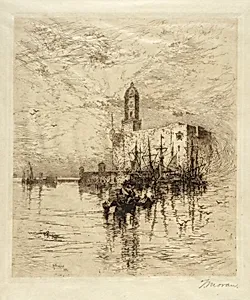
Castle of San Juan de Vlua, Vera Cruz
1884
Medium
Graphic Arts-Print
Classification
Graphic Arts-Print
Department
Smithsonian Collection
Museum
Smithsonian American Art Museum
Credit
Smithsonian American Art Museum, Museum purchase
Accession Number
1969.20.11
Rights
Public Domain
Tags
Art Historical Context
Thomas Moran's *Castle of San Juan de Ulúa, Vera Cruz* (1884) captures the imposing silhouette of one of Mexico's most storied fortresses, perched on a rocky island off the coast of Veracruz. This graphic arts print depicts the historic stronghold amid a vast sea, with boats dotting the waters, evoking the site's dramatic maritime role. Moran, a master of the Hudson River School and renowned for his luminous landscapes of the American West, here turns his gaze southward, blending romantic realism with meticulous detail to convey the fort's rugged grandeur. Built by the Spanish in the 16th century, Fort San Juan de Ulúa served as a vital defense against pirates and invaders, later becoming a prison during Mexico's turbulent independence era and beyond. Moran's print highlights its strategic isolation and weathered majesty, reflecting 19th-century American fascination with exotic locales amid growing U.S.-Mexico cultural exchanges post the Mexican-American War. As a museum purchase now in the Smithsonian American Art Museum's collection, this work exemplifies Moran's skill in printmaking, translating his painterly vision into accessible graphic form. It invites visitors to ponder the layered histories of colonial fortification and exploration, where stone walls meet endless seas.
About the Artist
Thomas Moran · 1837–1926
Thomas Moran (1837–1926) was an American painter and printmaker of the Hudson River School whose dramatic paintings of the American West played a pivotal role in the creation of the national parks. Born in Bolton, Lancashire, England, he emigrated with his family to Philadelphia as a child. He was largely self-taught, though he apprenticed briefly with a wood engraver and studied the work of J.M.W...