
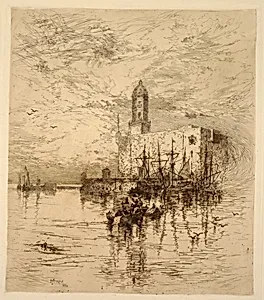
The Castle of San Juan d' Ulloa, Vera Cruz, Mexico
Classification
architecture
Department
Smithsonian Collection
Museum
Smithsonian American Art Museum
Credit
Smithsonian American Art Museum
Accession Number
1952-156-28
Rights
Public Domain
About this artwork
Research in Progress
Art Historical Context
Thomas Moran (1837–1926), a British-born American artist celebrated for his luminous landscapes, brings his masterful touch to *The Castle of San Juan d'Ulloa, Vera Cruz, Mexico* (1884). A key figure in the Hudson River School movement, Moran was renowned for dramatic depictions of natural wonders, often infused with romantic light and atmosphere. This work shifts focus to architecture, showcasing the imposing 16th-century fortress in Veracruz—a strategic Spanish stronghold that guarded Mexico's eastern coast and witnessed pivotal events in colonial history, from Hernán Cortés's arrival to later naval battles. Classified as architecture within the Smithsonian American Art Museum's collection, the piece highlights Moran's skill in rendering monumental structures against expansive skies, likely emphasizing texture, scale, and environmental interplay. Though the medium remains unidentified amid ongoing research, it exemplifies his ability to evoke a sense of place and history, bridging American artistic traditions with international subjects. Visitors to the Smithsonian will appreciate how Moran's vision transforms a distant fortress into an accessible marvel, inviting reflection on exploration and endurance. (198 words)