
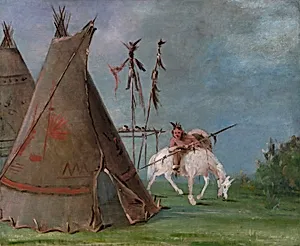
Comanche Lodge of Buffalo Skins
1834-1835
Medium
Painting
Classification
Painting
Department
Smithsonian Collection
Museum
Smithsonian American Art Museum
Credit
Smithsonian American Art Museum, Gift of Mrs. Joseph Harrison, Jr.
Accession Number
1985.66.493
Rights
Public Domain
Tags
About this artwork
With the arrival of horses on the Great Plains, nomadic hunters like the Comanche, who had previously relied on dogs to transport the poles and covers of their tipis, could live in much bigger and heavier shelters. George Catlin’s painting shows the horseman Little Spaniard arriving in camp, and was sketched at a Comanche village in 1834.
Art Historical Context
George Catlin's *Comanche Lodge of Buffalo Sk* (1834-1835) captures a vibrant moment in Comanche life on the Great Plains. Painted during Catlin's extensive travels among Native American tribes, the oil painting depicts the horseman Little Spaniard riding into camp, his full-length figure framed against a massive tipi constructed from buffalo hides. Sketched on-site at a Comanche village in1834, it reflects Catlin's firsthand immersion in these nomadic communities, part of his lifelong mission to document Indigenous cultures through realistic, ethnographic portraits and scenes. The artwork highlights a pivotal shift in Plains Indian life: the arrival of horses from Spanish colonizers revolutionized mobility. Previously, Comanches relied on dogs to haul lighter tipi poles and covers; now, they built grander, heavier lodges that offered better protection and status. Catlin's keen observation preserves this cultural adaptation, showcasing the horse's central role—evident in the tags of horse, teepee, and Comanche. Housed in the Smithsonian American Art Museum (gift of Mrs. Joseph Harrison, Jr.), this Western painting exemplifies Catlin's Romantic style, blending artistic beauty with historical urgency to educate future generations about a dynamic era on the frontier.
About the Artist
George Catlin · 1796–1872
George Catlin (1796–1872), born in Wilkes-Barre, Pennsylvania, to Putnam Catlin and Polly Sutton—who had been captured by Native Americans during the 1778 Battle of Wyoming—initially pursued a legal career. Trained at Litchfield Law School, he was admitted to the bar in 1819 but abandoned law after two years to study art in Philadelphia in 1823. Self-taught as a portraitist, Catlin quickly gained ...