
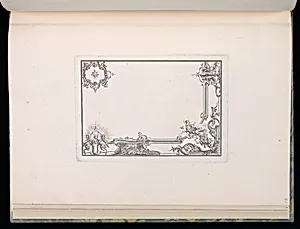
Design for Ceiling Ornament
Medium
Bound print
Classification
Bound print
Department
Smithsonian Collection
Museum
Smithsonian American Art Museum
Credit
Purchased for the Museum by the Advisory Council
Accession Number
1921-6-282-82
Rights
Public Domain
About this artwork
Research in Progress
Art Historical Context
François de Cuvilli the Elder (1695–1768), a Belgian-born architect and designer who thrived in the Bavarian court, created this *Design for Ceiling Ornament sometime between 1731 and1768. As a master of Rococo style, Cuvilliés was renowned for his intricate, playful decorations that graced palaces like Munich's Amalienburg Pavilion. This bound print captures the era's love for lavish interiors, where ceilings became canvases for scrolling motifs, shells, and floral arabesques—hallmarks of Rococo's elegant exuberance. Produced as a print bound into a volume, the work reflects 18th-century practices for sharing architectural ideas. Architects and artisans across Europe relied on such publications to replicate sophisticated designs, democratizing high-style ornamentation. Cuvilliés' output, including influential pattern books, helped spread Bavarian Rococo influences far beyond Germany. Held in the Smithsonian American Art Museum's collection—purchased by the Advisory Council—this piece underscores the transatlantic appeal of European decorative arts. Though research continues, it invites us to imagine opulent chambers alive with gilded fantasy, a testament to Cuvilliés' enduring legacy in ornamental design.